Sy.No.819/Part, Kistapur Road, Medchal, Hyderabad.

Electro Hydraulic Coil Tilter vs Motorised Coil Tilter. What To Choose?
23 Oct 2025
Electro Hydraulic Coil Tilter vs Motorised Coil Tilter. What To Choose?
Handling heavy coils effectively and safely is a critical operation in metal processing, manufacturing, and logistics. The coil tilter, a key component in machinery used to rotate coils between horizontal and vertical stand positions, is central to this effort.
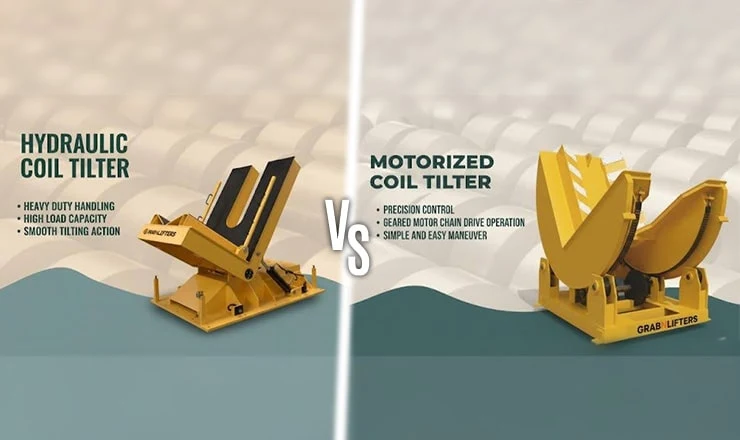
The choice of a tilter often centers on two main power systems: Electro-Hydraulic (EH) and Motorised (M). While both systems successfully achieve the final goal of coil rotation, their underlying mechanisms, performance characteristics, and ideal applications present unique strategic advantages. The correct selection represents a strategic alignment between technology and operational goals, impacting productivity, long-term costs, and safety.
Power Transmission: Distinct Mechanisms
- Electro-Hydraulic Coil Tilter: This system excels at energy transformation. An electric motor powers a hydraulic pump, which pressurizes fluid. This pressurized fluid is then meticulously channeled through valves and hoses to activate hydraulic cylinders. This method delivers a powerful and intrinsically smooth linear force, translating electrical energy into highly controlled, fluid-driven power.
- Motorised Coil Tilter: This system is defined by its highly efficient direct-drive principle. It uses one or more electric motors directly coupled to a mechanical drive system, typically incorporating a gearbox, couplings, and a precise screw jack or worm gear. This setup directly converts the motor’s rotary motion into the robust linear force necessary for tilting, emphasizing mechanical simplicity and direct action.
Comparative Analysis: Key Strategic Advantages
1. Power and Performance
| Electro-Hydraulic (EH) Advantage | Motorised (M) Advantage |
|---|---|
| Supreme Force Generation: EH systems are the ideal choice for unmatched raw power. Hydraulic cylinders generate immense force, making them the undisputed leader for handling the heaviest coils, often exceeding 50 tonnes. | Optimized Capacity Range: Motorised tilters are perfectly engineered for the low to medium capacity range, typically up to 20-30 tons, offering a powerful solution tailored for standard industrial loads. |
| Cushioned, Smooth Movement: The hydraulic mechanism inherently offers superior dampening and controlled motion, ideal for protecting high-value or delicate materials and ensuring precise, sensitive placement. | Direct, Rigid Movement: Motorised systems deliver a highly direct and responsive movement. When paired with Variable Frequency Drives (VFDs), they achieve excellent, precisely regulated speed control. |
| Built-in Shock Absorption: The fluid-based nature of the system naturally incorporates shock absorption, protecting the machinery and the coil from sudden load changes. |
2. Maintenance and System Longevity
| Electro-Hydraulic (EH) Advantage | Motorised (M) Advantage |
|---|---|
| Robust Fluid Power: The system relies on durable, field-tested components (pumps, valves, high-pressure seals) designed to withstand the stress of extreme force applications, ensuring longevity in heavy-duty cycles. | Streamlined Mechanical Simplicity: M-tilters feature a highly integrated and clean design with fewer moving components. The absence of hydraulic fluid simplifies the operating environment and eliminates fluid-related contamination risks. |
| Scheduled Expertise Requirement: Maintenance protocols focus on specialized, scheduled care, including fluid quality checks and filter replacements, ensuring the hydraulic power remains at peak, optimized performance. | High Operational Uptime: Maintenance is streamlined, usually requiring only periodic lubrication of the gears and routine electrical checks, which contributes to exceptionally high operational uptime and reduced complexity for in-house teams. |
3. Energy Efficiency
| Electro-Hydraulic (EH) Advantage | Motorised (M) Advantage |
|---|---|
| System Readiness: The design maintains continuous pressure, ensuring the system is instantly ready to apply maximum force the moment it is commanded, which is an advantage for rapid, high-demand cycling. | Superior Energy Conservation: Fully electric M-systems demonstrate remarkable efficiency by utilizing an on-demand operation principle. Power is consumed only during the active tilting motion, leading to lower kilowatt consumption and reduced operational temperatures. |
| Thermal Output: The transformation of electrical to hydraulic power generates systemic heat, which can be beneficial in maintaining operational fluid temperatures and readiness in cooler working environments. | Direct Power Transfer: The direct-drive nature minimizes energy loss associated with power conversion stages, ensuring that almost all input energy is dedicated to the required mechanical work. |
4. Control and Positioning
| Electro-Hydraulic (EH) Advantage | Motorised (M) Advantage |
|---|---|
| Nuanced Motion Profiling: EH systems offer very fine control over acceleration and deceleration via proportional valves, allowing for highly complex and smooth motion profiles necessary for the most sensitive positioning requirements. | Secure, Drift-Free Holding: A mechanical drive system, especially those using a ball screw, provides an unparalleled safety advantage: it is intrinsically self-locking. The load remains securely held in place with zero drift when the motor is turned off. |
| Smooth Load Transitions: The fluid power system provides excellent control when initiating movement under heavy load, ensuring a fluid transition from a static to a dynamic state without jarring. | Precise and Repeatable Positioning: Modern systems featuring servo motors or VFDs deliver consistently precise and highly repeatable final positioning, which is crucial for integration into automated assembly lines. |
Guiding Your Strategic Choice
The optimal choice aligns the tilter technology with your most critical operational priorities:
Choose an Electro-Hydraulic Coil Tilter if:
- Your primary need is supreme raw power for handling coils consistently under and above the 30-tonne range.
- You require smooth and cushioned movement to protect delicate or high-value materials.
- Your facility already possesses the expertise and infrastructure for the maintenance of specialized hydraulic equipment.
- The benefit of instantaneous maximum power is a critical performance metric.
Choose a Motorized Coil Tilter if:
- Energy efficiency and sustainability goals are key priorities for your operating budget.
- You require precise, repeatable, and inherently drift-free positioning for maximum safety during loading and offloading.
- You seek a system with simplified, fluid-free maintenance protocols and high mechanical uptime.
- Your capacity requirements are ideally suited to the low to medium range (up to 30 tonnes).