Sy.No.819/Part, Kistapur Road, Medchal, Hyderabad.

Equipments for Modern Steel Mill
27 March 2025
Equipments for Modern Steel Mill
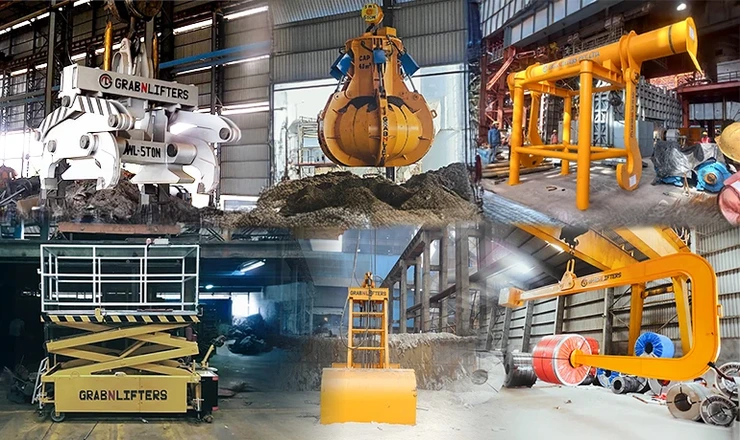
The furnace area is one of the most challenging in terms of environment in any steel mill, in the fast growth of steel production. Melt Shop equipment is required to be durable enough to endure intense conditions which are usually above 1200°C. Reliability, durability and efficiency are not an option in such environments, it is a must. Among the numerous tools of this process, special tongs are a very important interface between overhead cranes and red-hot steel, which guarantee safe and uninterrupted flow of materials.
The lifting solutions offer the mechanical strength needed to ensure production lines are running 24/7 with a reduced number of human contact and minimal operational hazards.
Although most tong systems are mechanical, automated systems are becoming common in modern steel mills to enhance efficiency and safety. Advancements include:
- Remote-controlled crane operations
- Load detectors and positioning sensors.
- Programmable handling sequences
- Interconnection with the control systems at the plant level.
FURNACE AREA CHALLENGES AND EQUIPMENT NEEDS
The furnace and casting areas are characterized by special operating problems. Equipment must endure:
- Thermal cycling and extreme temperatures.
- Vast weights and constant usage.
- Dust, slag and scale.
- Low tolerance to downtime.
The steel mills currently use strong and heat resistant and to a large extent mechanical machinery to tackle these issues so that they can be able to operate effectively without relying on the delicate electronics.
BILLET TONGS: EFFICIENCY IN BULK
Billet Tongs are essential in mills making long steel products. Billets are usually square and are manufactured at high volume and have to be stacked, stored and transported efficiently.
Key features include:
Maximum Penetration: these tongs are designed to give a firm no-slip grip, even when the work is heavy-duty. Their jaw structure is such that they can penetrate deep and hold well to minimize chances of accidents like drops.
Flexibility: They are able to work with single or multiple billets, typically 100 mm to 400 mm cross-section. This flexibility enables their applicability to a broad production need.
No-Power Advantage: They do not need electricity or magnetism, which is why they use lever systems and auto-latch mechanisms, thus are suitable in a place where electromagnetic interference may be a problem.
Billet tongs are preferred when dealing with high volumes because of their simplicity and reliability.
SLAB TONG: STABILITY FOR MASSIVE LOADS
The slabs tongs are large and heavy, and may weigh many tons. They have to be transported out of the continuous casting machine to rolling mills and the equipment used should be stable and precise.
Contemporary slab tongs provide:
High-Heat Resilience: These slab tongs have hard-faced gripping pads, which allows them to be used at temperatures up to 1200°C without deformation or excessive wear.
Automatic Operation: The auto-latch system enables the jaws to clamp and release automatically when it comes in contact.
Increased Stability: The design spreads out the weight, reducing the load swing and making transportation safe.
This durability and automation combination is of great benefit to productivity in operations of slabs handling.
INGOT TONG: THE UNIVERSAL GRIP
In such cases, specially developed equipment is required which can hold cylindrical or irregular shaped items.
Key characteristics include:
Manufactured Profiles of Jaws: You can make tongs work in a square, round, or even octagonal shape. This makes sure that the products will stay in place no matter what their shape is.
Flexible Configurations: These tongs come in simplex (one point lifting) or duplex (two point lifting) designs, and can be chosen according to the length of the load, weight and stability needs.
Secure Handling: The design reduces any slip, even when using smooth or hot surfaces.
Their versatility renders them a vital instrument in various functioning of steel mills.
SAFETY CONSIDERATIONS IN HANDLING EQUIPMENT
Safety is paramount in steel mills, more so in high temperature areas. Machines should be such that they avoid accidents and offer protection to the operator.
Important safety practices:
- Checking the components regularly for damages.
- Heat-resistant materials and protective coating used.
- Operational and maintenance staff training.
- Lifting equipment to be equipped with fail-safes.
A proper handling system does not only guarantee the safety of workers, but also guarantees continuous production.
CONCLUSION
Modern steel mills use equipment that is tailored to the extreme conditions of high-load, high-temperature conditions. Billet lifting tongs up to the high-tech slab handling equipment, each of the mentioned tools is essential in ensuring efficiency, safety, and productivity.
The further development of these technologies especially on automation and material science has helped the steel mills to run more precisely and reliably than ever. With the help of effective, high-quality equipment and a strict compliance with the rules of work, the manufacturers of steel will be able to provide the work with smoothness, safety, and cost-effectiveness even in the most difficult situations.