Sy.No.819/Part, Kistapur Road, Medchal, Hyderabad.

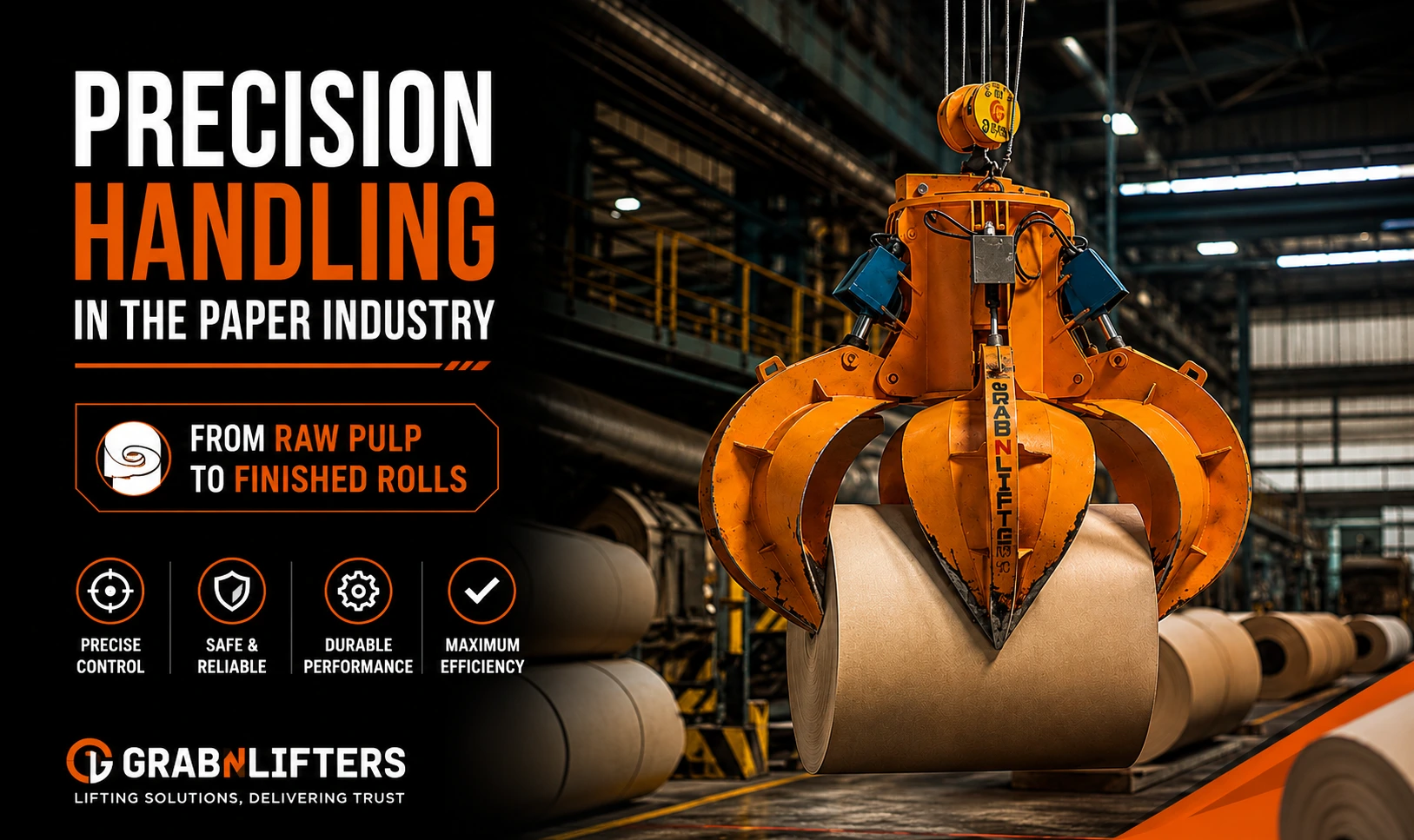
Precision Handling in the Paper Industry from Raw Pulp to Finished Rolls
27 May 2026
Precision Handling in the Paper Industry from Raw Pulp to Finished Rolls
The work of the paper industry also has a certain paradox; the products are not only heavy but also very delicate. Starting with raw pulp processing and ending with the finished roll, each process requires accuracy. Handling mistakes can lead to great losses even when they are minor. A pin-point-sized mark on the side of a 2 ton roll of paper, e.g. can result in kilometers of waste material in the downstream product processing or printing.
Special material handling equipment is important to ensure high throughput but at the same time maintain the quality of products. These systems are created with a purpose of lifting and transporting, as well as safeguarding the structural stability of paper products during the production process.
THE CHALLENGE: BALANCING WEIGHT AND FRAGILITY
The handling of paper products, large rolls, and bundled sheets should be handled with great care as they can easily be deformed. As compared to steel or other rigid materials, paper can easily experience the following:
- Edge damage and crushing.
- Surface contamination or marking.
- Telescoping (uneven movement of roll layers)
- Loss of structural alignment
Meanwhile, these products may weigh up to several tons and have to be lifted with powerful solutions. This vulnerability coupled with massiveness renders accuracy in handling a significant requirement in paper mills and printing plant.
PAPER ROLL TONGS: SPECIALIZED OD GRIPPERS
Working with cylindrical parent rolls entails the use of equipment that is able to hold on to them without deforming them. Paper roll tongs are commonly used to do this especially those that are designed as outer diameter grips.
Key features include:
Outer Diameter (OD) Gripping: These tongs are used to grip the roll with shaped arms on the outside. The design guarantees the distribution of pressure evenly over the roll surface without any localized stress points.
Surface Protection: To prevent the outer layers of the high-quality paper to be damaged, protective pads of such materials as polyurethane or aluminum are attached to the gripping arms. Such pads reduce friction and avoid marking.
Motorized Rotation: In high-density storage systems motorized tongs enable 360-degree rotation. This allows operators to conveniently roll in horizontal orientation and roll in vertical orientation, enhancing storage efficiency and flexibility of handling.
SHEET AND BALE HANDLING: MECHANICAL LATCH OPERATIONS
The paper sheets and bales of recycling that are flat-wrapped need another way of handling. Speed, reliability, and safety are the main issues in such cases. Mechanical latch tongs are usually employed, providing:
Auto-Latch Technology: These tongs have a mechanical touchdown mechanism. The crane operator is also able to connect or release the load by merely lowering the tongs onto the load and does not require manual operation.
Safety in Hands: As manual hooking is not required, workers will be able to stay in a safe place in the area of lifting. This goes a long way in minimizing the chances of injuries in the workplace.
Stable Grip: These tongs are designed to provide a stable grip on the recycling bale, so even loosely packed bales can be transported and lifted securely.
J-HOOKS AND LIFTING BEAMS: BUNDLE MANAGEMENT
In working with a bundle or roll of paper on a shaft or arbor, it is important to be stable. Lifting should be performed in an even way, as otherwise the load can shift, thereby damaging the product or causing safety issues.
One typical solution is to use J-hooks with lifting beams:
Load Distribution: The load weight is uniformly distributed over two or more J-hooks on the lifting beam giving stability during lifting.
Level Handing: This arrangement maintains the load absolutely horizontal, a requirement where working with wide paper bundles or with long shafts.
Adjustable Spread: A lot of lifting beams are adjustable, so that operators can fit the beams to various bundles and shapes.
The solution is a reliable and versatile system to manage heavy and cumbersome-shaped loads.
LIFT AND TRANSFER SYSTEMS: MOVING ACROSS THE FACILITY
The paper industry does not just stop at crane operations in efficient material handling. Big plants usually need special equipment to transport goods between levels and even across the manufacturing sites.
SCISSOR LIFTS FOR VERTICAL MOVEMENT
Scissor lift is necessary in plants or warehouses that are multi-level, when the heavy paper stock or equipment need to be transferred between the levels. Scissor lifts come in handy especially where conventional lifts are not feasible or adequate.
TRANSFER TROLLEYS FOR HORIZONTAL MOVEMENT
Transfer trolleys are an efficient solution when it comes to the transfer of materials between various processing stations, e.g. storage to a rewinder or cutting line.
Key benefits include:
- Less use of overhead cranes in short distance transportation.
- Better handling of heavy loads.
- Also available as rail-guided or battery-operated systems
SAFETY AND MAINTENANCE CONSIDERATIONS
Because of the sensitive character of paper products and the weight of loads, safety and maintenance are crucial.
Best practices include:
- Regular checks of hoisting equipment and cushions.
- Ensure that the tongs are lined up correctly.
- Washing surfaces regularly.
- Make sure operators are trained properly.
TO CONCLUDE
One of the pillars of quality and efficiency in the paper industry is precision handling. Whether it is specialized paper roll tongs, or highly sophisticated transfer systems every item of equipment is geared to the strength-delicacy balance.
Having invested in the appropriate handling solutions and modern technologies, the paper manufacturers will be able to reduce waste and enhance safety and high standards that are demanded in the current competitive market.
With the ever-increasing production requirements, the importance of precision handling equipment will only increase in the need to facilitate smooth and dependable processes of raw pulp to finished rolls.